



One of the most common questions people ask before LASIK right after “is it safe?” is whether the results actually last. Nobody wants to spend money on a procedure only to be back in glasses a few years later. It’s a fair concern and deserves a straight answer.
Here it is: for most people, LASIK results are permanent. But there are a few important nuances to that statement worth understanding before you book your consultation.
What LASIK Actually Does
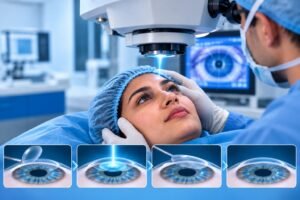
To understand how long results last, it helps to understand what the procedure changes. LASIK uses a laser to permanently reshape your cornea the clear front surface of your eye so that light focuses correctly on your retina. That reshaping is permanent. The cornea doesn’t regenerate back to its original shape after surgery.
So in that sense, what LASIK does to your cornea lasts a lifetime.
Why Vision Can Change After LASIK

The corneal change is permanent. But your eye is a living structure that continues to change with age and that’s where the nuance lies.
Natural ageing of the eye After 40, most people develop presbyopia the gradual loss of near focusing ability caused by the natural lens inside the eye losing flexibility. This has nothing to do with the cornea and nothing to do with LASIK. It happens to everyone, with or without surgery. So if you had LASIK at 30 and find yourself needing reading glasses at 45, that’s not LASIK wearing off that’s a completely separate age-related change.
Prescription progression in younger patients In some patients particularly those who had LASIK in their early twenties with a higher prescription the underlying myopia can continue to progress slightly after surgery. This is more common in people whose prescription wasn’t fully stable at the time of surgery, which is exactly why surgeons insist on prescription stability for at least one to two years before proceeding.
Regression A small percentage of patients experience regression where the eye gradually drifts back toward the original prescription over time. It tends to be more common in those who had higher prescriptions corrected. Regression doesn’t happen overnight. It’s a slow shift that may take years to become noticeable, and if it affects vision significantly, an enhancement procedure can often address it.
What Percentage of People Maintain Their Results Long-Term?
Studies tracking LASIK patients over ten to fifteen years consistently show that the large majority well over 90 percent maintain excellent, stable vision without needing glasses for distance tasks. The small percentage who experience regression or prescription progression
typically have predictable risk factors that a thorough pre-surgery evaluation would have identified.
What About Enhancement Procedures?
If vision does shift over time, LASIK enhancement a secondary procedure to fine-tune the result is an option for many patients. Whether an enhancement is possible depends on how much corneal tissue was available after the original surgery. This is one of the reasons surgeons are conservative with how much corneal tissue they remove leaving room for a future enhancement if needed.
Ask your surgeon upfront about their enhancement policy and at what point they would consider it.
Making Results Last What You Can Do
While LASIK results are largely self-sustaining, a few habits genuinely support long-term visual health:
Get regular eye check-ups even after successful LASIK annually is ideal
Manage screen time and take breaks to reduce long-term eye strain
Wear good quality UV-protective sunglasses outdoors
Stay on top of overall health conditions like diabetes can affect eye health over time
Report any changes in vision to your eye doctor promptly rather than waiting
Getting the Right Information Before You Decide
Understanding longevity is part of making an informed decision about LASIK. The best doctors for LASIK eye surgery in Gurugram will be honest about your individual risk factors whether your prescription is stable enough, how high your correction is, and what a realistic long-term outlook looks like for your specific eyes. That conversation should happen before surgery, not after.
For patients who are also managing other eye conditions alongside refractive concerns, the best eye clinic in Gurgaon for cataract surgery offers comprehensive eye care under one roof so whether your question is about LASIK longevity, early lens changes, or age-related vision shifts, you’re getting answers from a team that sees the full picture.
conclusion
LASIK results are permanent in the sense that the corneal reshaping doesn’t reverse. For most people, vision remains stable and clear for decades. The changes that sometimes occur later presbyopia, mild regression, or prescription shift are separate from the
Frequently Asked Questions
For most people, LASIK provides long-lasting vision correction, and the results can remain stable for many years. LASIK permanently reshapes the cornea, so the tissue removed during the procedure does not grow back. However, your eyes can naturally change with age or due to other eye conditions. Some people may experience a gradual change in their prescription years after surgery. Regular eye examinations can help monitor your vision and overall eye health.
Yes, vision can change after LASIK, although significant regression is not common. Factors such as age, natural changes in the eye, hormonal changes, or certain eye conditions may affect your prescription. If a small prescription returns, glasses or contact lenses may be sufficient. In selected cases, an enhancement procedure may be considered after a detailed eye examination.
LASIK permanently changes the shape of the cornea, but it cannot stop the natural ageing process of your eyes. Most patients enjoy clear vision for many years following surgery. After around age 40, many people develop presbyopia, an age-related difficulty focusing on nearby objects. This can happen even when distance vision remains excellent after LASIK.
Some people may eventually need glasses after LASIK. This does not necessarily mean the surgery has failed. Age-related vision changes, particularly presbyopia, can cause difficulty with reading or close-up tasks. Some patients may also experience changes in their distance prescription over time. Your eye specialist can determine whether glasses, contact lenses, or another treatment is appropriate.
In some cases, a LASIK enhancement may be possible if vision changes after the initial procedure. However, not everyone is suitable for another treatment. The decision depends on factors such as corneal thickness, eye health, residual prescription, and the stability of your vision. A comprehensive eye examination is necessary before considering an enhancement.
LASIK results can remain stable after 40, but natural age-related changes can still affect vision. Presbyopia commonly develops around this age, making it harder to focus on nearby objects. Therefore, someone who had excellent distance vision after LASIK may eventually need reading glasses. This is an age-related change rather than LASIK wearing off.