




One of the most common questions patients ask after cataract surgery is whether the cataract can come back. It’s a completely understandable concern, especially when vision starts to blur again months or years after surgery and everything feels like it’s back to square one.
Dr. Keya Barman, Founder and Chief Ophthalmologist at Barman Eye Care Centre Gurugram, holds an MS in Ophthalmology and a Fellowship in Cataract and Refractive Surgery. With over two decades of surgical experience and membership in the All India Ophthalmological Society, she addresses this question with every cataract patient she sees.
Her answer is straightforward: a true cataract cannot come back. But something else can, and that’s what most people are actually experiencing.
Why a Cataract Cannot Return
During cataract surgery, the cloudy natural lens of the eye is completely removed and replaced with a clear artificial lens called an IOL. Because the natural lens, the structure where cataracts form, has been taken out entirely, there is no tissue left in which a cataract could redevelop.
The artificial lens does not contain the biological proteins that cloud and aggregate to cause cataracts. Once your natural lens is out, it is gone permanently. So a true cataract returning after surgery is not possible.
So What Is Happening When Vision Blurs Again?

What patients often experience is a condition called Posterior Capsule Opacification or PCO. It is sometimes referred to as a “secondary cataract,” which is where the confusion comes from. But PCO is not a cataract.
During surgery, the back portion of the natural lens capsule a thin transparent membrane is left intact to hold the new artificial lens in place. Over time, residual cells on the inner surface of this capsule can multiply and cause it to become cloudy. When this happens, light scatters instead of passing through cleanly, and vision becomes hazy again.
The symptoms feel very similar to the original cataract, blurry vision, increased glare, difficulty reading, and colours appearing less vivid. This is why many patients assume the cataract has returned.
How Common Is PCO?

PCO is actually the most common complication after cataract surgery. It can develop anywhere from a few months to several years after the procedure. Not every case causes significant symptoms, some patients have mild capsule changes that don’t meaningfully affect their vision.
Younger patients tend to have a higher risk of developing PCO. The design and material of the artificial lens also plays a role, modern square-edge IOL designs have significantly reduced PCO rates compared to older lens designs.
How Is PCO Treated?
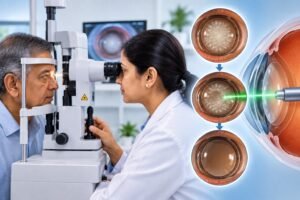
Here is the reassuring part. PCO is treated with a quick, painless laser procedure called YAG laser capsulotomy. It takes about five minutes, requires no incisions or injections, and is done as an outpatient procedure.
A laser creates a small precise opening in the cloudy capsule, allowing light to pass through clearly again. Most patients notice vision improvement within 24 hours. Once done, the opening is permanent, PCO does not return in the treated area.
It is one of the safest and most effective procedures in eye care, and it is routinely available at a good cataract centre.
When Should You Get Checked?
Any noticeable change in vision after cataract surgery gradual blurring, increasing glare, or a sense that your surgical result is “wearing off” should be properly evaluated. Don’t assume it’s PCO and don’t ignore it. Other causes like retinal changes or IOL displacement can produce similar symptoms and need different treatment entirely.
The Best cataract hospital in Gurugram provides structured post-operative follow-up that monitors lens capsule clarity and overall eye health well beyond the initial recovery, so changes like PCO are caught and treated early.
For anyone considering surgery, the Best cataract surgery in Gurgaon at Barman Eye Care Centre includes careful IOL selection that reduces PCO risk from the outset and in-house YAG laser treatment when needed, so patients never have to go elsewhere for follow-up care.
The best eye clinic in Gurgaon for cataract surgery is one that stays with you through the entire journey not just on the day of the procedure.
Conclusion
Cataracts cannot return after surgery. What can develop is PCO a clouding of the capsule behind the artificial lens, which is common, easily treated, and nothing to be alarmed about. If your vision has changed after cataract surgery, get it examined. The cause is almost always treatable when identified early.
Frequently Asked Questions
No, a cataract cannot come back after successful cataract surgery because the cloudy natural lens is removed and replaced with an artificial intraocular lens (IOL). However, some patients may develop posterior capsule opacification (PCO), commonly called a “secondary cataract.” This is not a new cataract. It happens when cells grow on the capsule behind the artificial lens, causing vision to become cloudy or blurred again. PCO can usually be treated with a quick YAG laser procedure.
Cloudy vision after cataract surgery can have several causes. One common reason is posterior capsule opacification, where the membrane supporting the artificial lens becomes cloudy. Other possibilities include dry eyes, changes in the retina, swelling, inflammation, or a change in glasses prescription. If vision becomes blurry after initially being clear, an eye examination is important to determine the exact cause rather than assuming that the cataract has returned.
A “secondary cataract” is a common term used for posterior capsule opacification (PCO), but it is not actually a new cataract. During cataract surgery, the cloudy natural lens is removed while the capsule that supports the artificial lens is usually preserved. In some patients, cells can grow on this capsule and make it cloudy over time. This can cause blurred vision, glare, or difficulty seeing clearly. A YAG laser procedure can usually restore clarity without removing the artificial lens.
Posterior capsule opacification can develop months or even years after cataract surgery. The timing varies from person to person. Some patients may never develop significant PCO, while others may notice gradual changes in vision. Symptoms can include blurred vision, glare, reduced contrast, or difficulty seeing clearly. If your vision becomes cloudy after cataract surgery, an ophthalmologist can examine the eye and determine whether PCO or another condition is responsible.
Yes. PCO is commonly treated using a YAG laser capsulotomy, which is a laser-based procedure rather than traditional cataract surgery. The laser creates a small opening in the cloudy posterior capsule, allowing light to pass clearly through the artificial lens. It is generally a quick outpatient procedure, and the ophthalmologist will determine whether it is appropriate based on your eye examination and symptoms.
Regular eye examinations are important for monitoring your vision and overall eye health after cataract surgery. Protecting your eyes from excessive UV exposure, managing conditions such as diabetes, following prescribed eye-drop instructions, and reporting new changes in vision can help support long-term eye health. If you experience sudden vision loss, severe pain, flashes, or a sudden increase in floaters, seek urgent ophthalmic evaluation.