



Most people think of the retina as just one single thing, the part of your eye that “sees.” But here’s something that surprises a lot of people: the retina isn’t one flat layer at all. It’s actually made up of several distinct layers, each doing a very specific job. And when even one of these layers gets damaged, vision can be affected in ways that are easy to misunderstand if you don’t know what’s actually happening back there.
So let’s break this down in a way that actually makes sense.
The Retina Isn’t Just “One Thing”
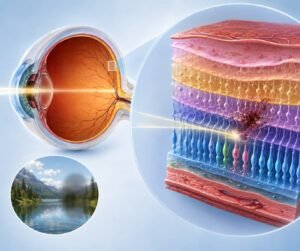
Think of the retina less like a single sheet and more like a multi-layered sandwich, sitting at the back of your eye. Light enters through the cornea and lens, travels through the eye, and lands on this layered structure, which then converts that light into electrical signals your brain can actually understand.
Each layer plays its own role in that process. Skip or damage one, and the whole chain gets disrupted, even if the rest of the eye is perfectly healthy.
Breaking Down the Key Layers
The Retinal Pigment Epithelium (RPE)
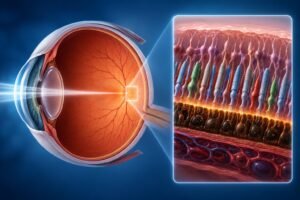
This is the outermost layer, sitting right behind the light-sensing cells. Its job is mostly support nourishing the photoreceptor cells above it and clearing away waste. It also absorbs scattered light so it doesn’t bounce around and blur your vision. Damage here is exactly what happens in conditions like age-related macular degeneration.
Photoreceptor Layer (Rods and Cones)
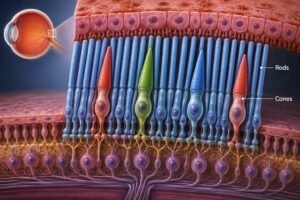
This is where the real action begins. Rods help you see in low light and pick up movement, while cones are responsible for color vision and sharp detail, especially in bright light. Your central vision the kind you use for reading or recognizing a face depends heavily on cone density in one specific spot called the macula.
Bipolar Cell Layer
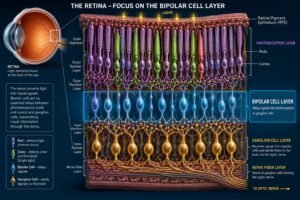
Once light is converted into a signal by the photoreceptors, bipolar cells act like a relay station, passing that information further along. They also start the process of fine-tuning the signal, deciding what’s worth amplifying and what isn’t
Ganglion Cell Layer
This layer takes all the processed information and bundles it into nerve fibers that eventually form the optic nerve. These cells are essentially the final exit point the signal leaves your eye here and heads straight to your brain. This is also the layer that gets progressively damaged in glaucoma, which is part of why glaucoma can cause permanent vision loss if it isn’t caught early.
Nerve Fibre Layer
This is the layer where all those ganglion cell extensions group together before exiting the eye as the optic nerve. Think of it as the final cable bundle carrying everything to your brain in one coordinated stream.
Why Does This Layered Structure Actually Matter?
Because each layer is so specialized, damage doesn’t behave the same way everywhere. A problem in the RPE shows up as blurred central vision over time. A problem in the ganglion cell layer can quietly eat away at your peripheral vision for years before you even notice. A problem with the photoreceptors might affect your night vision long before it touches your ability to read in daylight.
This is exactly why two people with “retina problems” can have completely different symptoms. It all depends on which specific layer is involved.
What This Means for Diagnosis and Treatment
Understanding which layer is affected isn’t just academic it directly changes how a condition gets treated. This is why modern eye centers rely on imaging technology like OCT scans, which can actually show each individual layer of the retina in detail, rather than just giving a general picture.
The best eye doctors and specialists in Gurgaon use this kind of layer-by-layer imaging to pinpoint exactly where a problem is originating, instead of guessing based on symptoms alone. A proper evaluation at the Best Eye Hospital In Gurgaon can catch subtle layer-specific changes well before they turn into noticeable vision loss.
If you’re also dealing with age-related changes like cataracts alongside any retinal concerns, a best eye clinic in Gurgaon for cataract surgery can coordinate care so both issues are addressed without one masking the other during examination.
For anyone noticing changes in night vision, side vision, or central clarity, visiting a best retina-uvea surgery treatment in Gurgaon for a detailed retinal scan is far more useful than waiting to see if things improve on their own. A trusted best eye center in Gurugram offering thorough Best Eye Treatment in Gurgaon can map out exactly what’s happening at each layer and guide you accordingly.
Conclusion
Your retina works as a team of layers, not a single surface, and that’s exactly why vision problems can show up in such different ways depending on what’s affected. Getting a detailed, layer-specific eye exam through reliable best eye care in Gurugram isn’t just a precaution, it’s often the only way to catch a problem before it becomes permanent.
Book Your Consultation Today
At Barman Eye Care, Gurgaon, we use advanced technology for a painless and precise procedure. Our expert ophthalmologists ensure personalized care for the best results.
Take the first step toward clearer vision! Schedule your consultation and step into spring with confidence.
Call us today to book your appointment!