


If you’ve been wearing glasses or contacts for years and finally started looking into LASIK, this question has probably crossed your mind more than once. And it’s a fair one. Any procedure involving your eyes deserves serious thought not just reassurance from a clinic that wants your business.
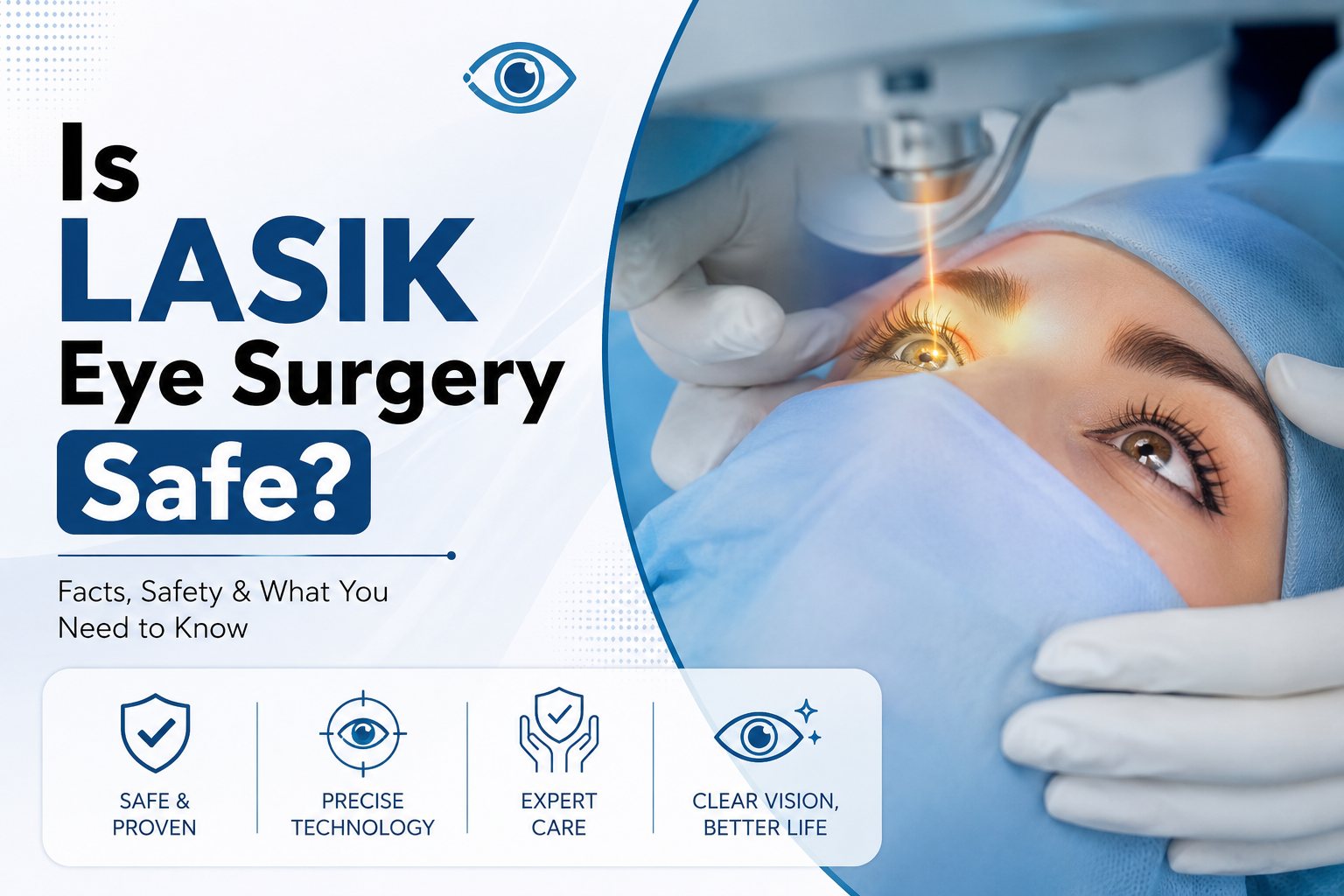
The Short Answer
Yes ,LASIK is safe. But that answer comes with an important condition that most people gloss over: it is safe when performed on the right candidate, by an experienced surgeon, using the right technology, after a thorough pre-surgery evaluation.
Remove any one of those elements, and the risk profile changes significantly.
What the Data Actually Shows
LASIK has been performed for over 30 years now. It is one of the most studied elective surgical procedures in the world, with a documented patient satisfaction rate consistently above 95 percent across large-scale studies. Serious, sight-threatening complications are extremely rare occurring in less than 1 percent of cases in well-screened patients.
That’s not marketing. That’s decades of clinical data from millions of procedures worldwide.
Where Things Can Go Wrong And Why
The vast majority of LASIK complications trace back to one root cause inadequate screening before surgery. When a patient who shouldn’t have had LASIK gets it anyway, problems like dry eyes, halos, glare, or in rare cases corneal instability can follow.
Here’s what proper screening should cover:
- Corneal thickness — too thin and LASIK isn’t appropriate
- Corneal topography — to rule out conditions like keratoconus
- Tear film quality — pre-existing dry eyes need to be assessed and managed first
- Prescription stability — a changing prescription needs time to stabilize before surgery
- Pupil size – relevant for night vision outcomes
A clinic that rushes you through this process or skips any part of it is the actual risk not the laser itself.
Common Side Effects – What’s Normal and What Isn’t
Some side effects after LASIK are expected and temporary:
Dry eyes – very common in the first few months as corneal nerves recover. Usually managed well with lubricating
drops and resolves on its own for most patients.
Halos and glare at night – common in the early weeks as the eye adjusts. Gradually improves as healing

progresses.
Genuinely permanent side effects are rare, and when they do occur, they are almost always linked to either pre-existing conditions that weren’t screened for, or poor surgical technique. Both are avoidable with the right team.
Who Shouldn’t Have LASIK?
LASIK is not for everyone and an honest surgeon will tell you this upfront. You may not be a suitable candidate if:
- Your corneas are too thin or have an irregular shape
- Your prescription is still changing year to year
- You have significant dry eye disease
- You have autoimmune conditions that affect healing
- You’re pregnant or breastfeeding
In these cases, alternatives like PRK, SMILE, or ICL surgery may be more appropriate. The goal is good vision safely not forcing one procedure onto everyone who walks in.
Questions Worth Asking Before You Say Yes
Before committing to any procedure, make sure you get clear answers to these:
- What do my corneal scans show am I a suitable candidate?
- What technology will be used for my surgery?
- What are realistic outcomes for my specific prescription?
- What does post-surgery follow-up look like?
- What happens if an enhancement is needed?
A surgeon who answers all of these patiently and specifically is one worth trusting.
Getting the Right Evaluation in Gurgaon
Safety in LASIK starts with the right people asking the right questions about your eyes. The best eye doctors and specialists in Gurgaon will run a complete pre-surgery workup corneal mapping, tear film assessment, topography, and biometry before making any recommendation. That thoroughness is what protects you, more than any technology or brand name.
Is LASIK eye surgery safe? In the right hands, with the right screening, for the right candidate absolutely. The question is not whether LASIK is safe in general. The question is whether it is safe for your specific eyes. And that answer can only come from a detailed, honest evaluation not from a website, and not from a clinic that treats every patient as a guaranteed candidate.
Conclusion
LASIK has a strong, well-documented safety record built over three decades. Most side effects are temporary. Serious complications are rare and largely preventable with proper screening. The biggest risk isn’t the laser it’s choosing the wrong clinic or skipping the evaluation that tells you whether LASIK is right for you in the first place. Get that part right, and everything else follows.
Frequently Asked Questions
LASIK is usually performed using numbing eye drops, so patients generally do not feel significant pain during the procedure. Some people may experience mild irritation, watering, or a gritty sensation temporarily afterward.
The actual laser treatment is usually very quick, often taking only a few minutes per eye. However, the complete appointment may take longer because of preparation and post-surgery checks.
Many patients notice improved vision within the first day or few days. However, complete visual stabilization can take several weeks or longer depending on individual healing.
Adults with stable vision and healthy eyes may be potential candidates. Eligibility depends on factors such as corneal thickness, prescription stability, eye health, and overall suitability determined during a comprehensive examination.