



If someone has told you that you need cataract surgery, the first thing that probably went through your mind wasn’t relief, it was anxiety. What exactly happens in there? Will it hurt? Will I be able to see anything during the procedure?
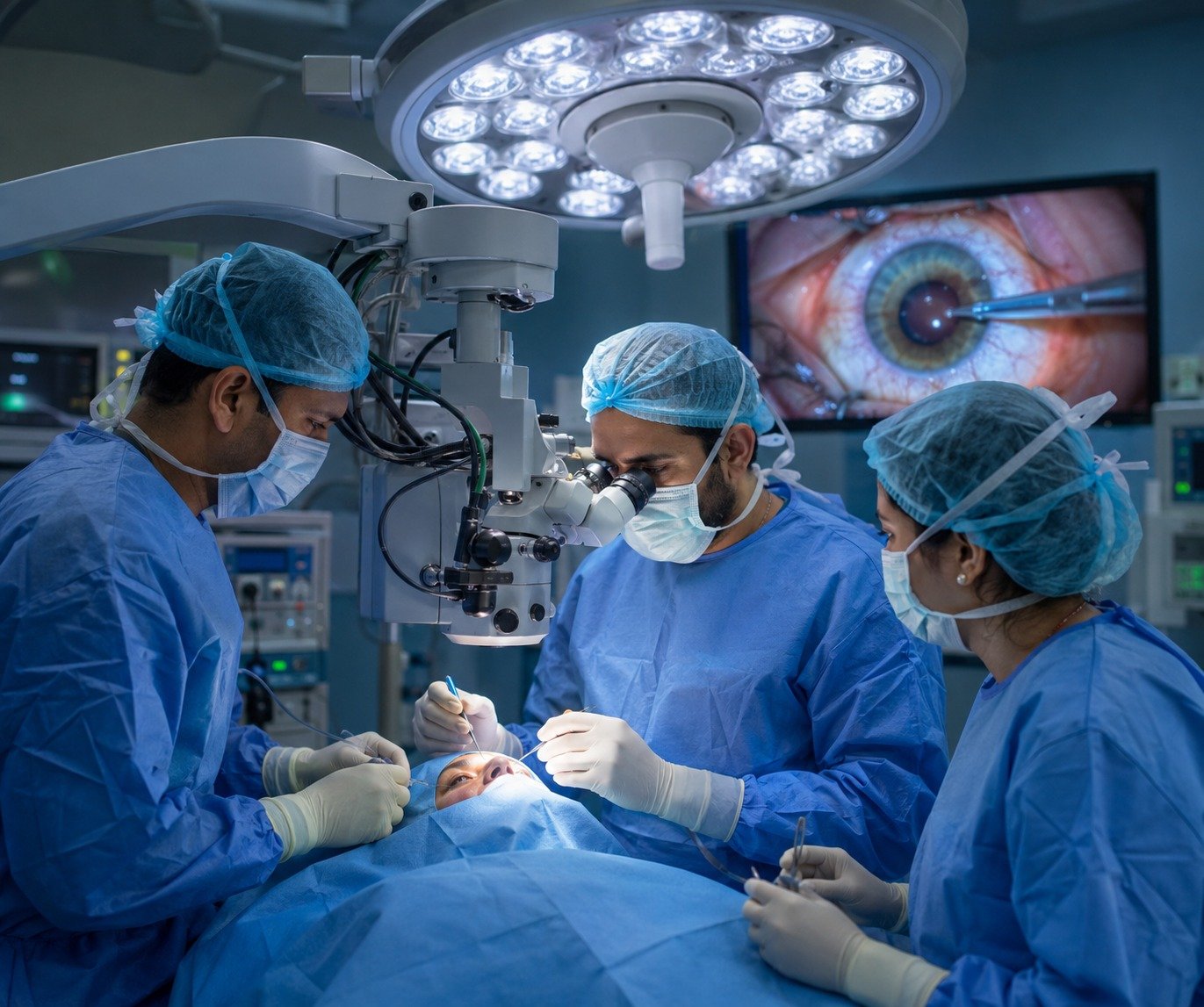
These are completely normal questions. And the best way to calm that anxiety is to actually understand what happens, step by step.
Before You Even Enter the Operation Theatre
Preparation starts well before the surgery day. In the weeks leading up, your doctor takes detailed measurements of your eye, the length of your eyeball and the curvature of your cornea. These measurements decide the power of the artificial lens that goes inside your eye. Getting this right is what determines how well you see after surgery.
On the day itself, you arrive a little early. Dilating drops are applied, the eye area is cleaned, and anesthetic drops are used to numb the eye completely. No injections. No general anesthesia. Just drops. A mild sedative is sometimes given to help you relax, but you stay awake throughout.
The Surgery: Step by Step
Once you’re on the table, a small device gently holds your eyelid open so blinking isn’t a concern.
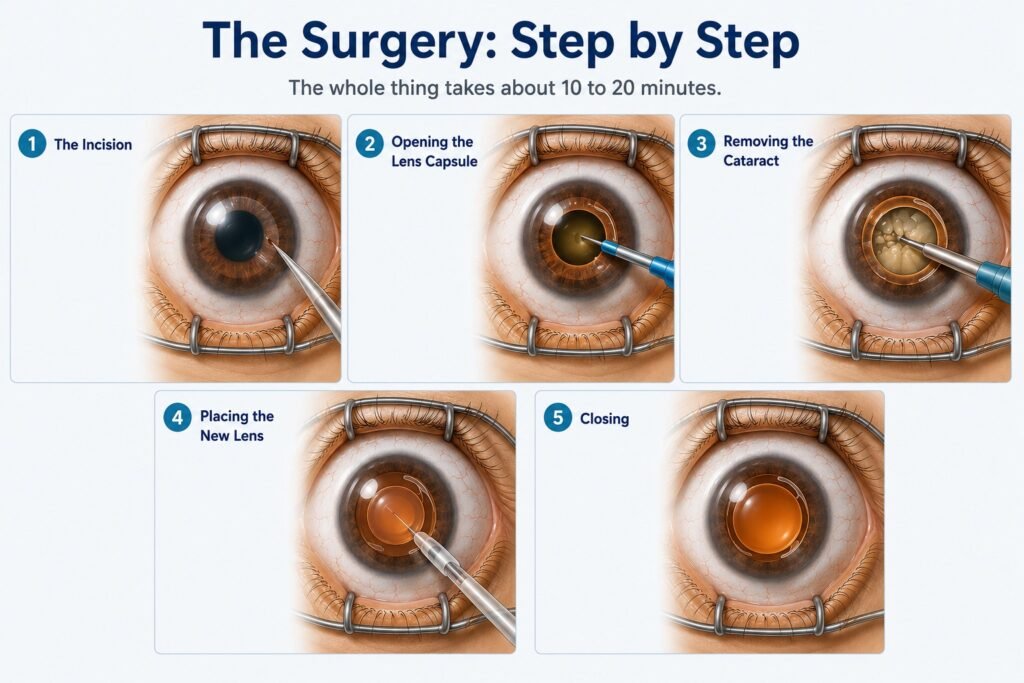
Step 1: The Incision
The surgeon makes a tiny 2 to 3 millimeter opening at the edge of your cornea. It’s so small it usually seals on its own without stitches.
Step 2: Opening the Lens Capsule
Your natural lens sits inside a thin bag called the capsule. A precise circular opening is made in the front of this capsule to reach the cloudy lens inside.
Step 3: Removing the Cataract
A small probe using ultrasound energy, called phacoemulsification, breaks the cloudy lens into tiny fragments. These are gently suctioned out. The back of the capsule is left intact as support for the new lens.
Step 4: Placing the New Lens
The artificial lens is folded, inserted through the same small incision, and unfolds inside the capsule. It sits there permanently. You won’t feel it, and it needs no maintenance.
Step 5: Closing The incision self-seals.
A protective shield goes over your eye. Done.
The whole thing takes about 10 to 20 minutes.
Most people are nervous about being awake. But you won’t see what the surgeon is doing in any detail. Most people describe seeing bright, hazy lights and colors, almost like an abstract light show. No pain. Some feel mild pressure, nothing more. The team talks to you throughout, which helps a lot.
Most patients are genuinely surprised by how quick and comfortable it actually is.
Right After Surgery
You rest briefly, then go home the same day. Vision may be blurry for a day or two while your eye adjusts. Most people notice a clear improvement within 24 to 48 hours.

Eye drops are prescribed for several weeks to prevent infection and support healing. Follow-up appointments monitor your recovery closely.
Why the Surgeon’s Experience Matters
Every step here, from incision placement to centering the new lens, requires precision and experience. The outcome isn’t just about what equipment is in the room. It’s about who is using it.
The best doctor for cataract in Gurugram will not only perform the procedure with skill but also make sure you go in fully informed and calm. That combination of clinical experience and honest communication makes a real difference to how your surgery and recovery go.
For everything before and after the procedure, best eye care in Gurugram means proper support at every stage thorough pre-surgery measurements, careful post-surgery monitoring, and genuine guidance whenever you have a question.
Conclusion
Cataract surgery is one of the most commonly performed and safest procedures in modern medicine. It takes about 15 minutes, causes no pain, and most people wonder why they waited so long once they can see clearly again. If surgery has been recommended for you, ask your questions, understand the process, and trust the right hands to take care of it.
Book Your Consultation Today
At Barman Eye Care, Gurgaon, we use advanced technology for a painless and precise procedure. Our expert ophthalmologists ensure personalized care for the best results.
Take the first step toward clearer vision! Schedule your consultation and step into spring with confidence.
Call us today to book your appointment!
Frequently Asked Questions
No, cataract surgery is generally not painful. The eye is numbed using anesthetic eye drops, so you may only feel slight pressure or mild discomfort during the procedure. Most patients remain awake and comfortable throughout the surgery.
Cataract surgery usually takes 15 to 30 minutes for one eye. However, you should expect to spend about 2–3 hours at the eye hospital for pre-surgery preparation, the procedure, and a short recovery period.
During cataract surgery, the surgeon removes the cloudy natural lens of your eye and replaces it with a clear artificial intraocular lens (IOL). The procedure is performed using advanced microsurgical techniques and is one of the safest and most successful eye surgeries available.
Many patients notice improved vision within 24 to 48 hours after cataract surgery. However, complete healing and stable vision may take 4 to 6 weeks, depending on your eye condition and how well you follow post-operative care instructions.
After cataract surgery, avoid rubbing your eyes, lifting heavy objects, swimming, and exposing your eyes to dust or dirty water for a few weeks. Always use the prescribed eye drops and follow your eye doctor's advice to ensure a smooth recovery.